

What is commentary in an essay? Authors often include all the important information in their essays, but sometimes it isn’t enough. Some essays require writers to use their own critical thinking and analytical skills throughout their content. That’s where commentaries come in.
A commentary in an essay helps in connecting evidence to your claim. It provides an in-depth understanding to your readers of why your claim matters. This article will explain what a commentary in an essay, how to write it and a commentary essay example at the end.
What is Commentary in an Essay?
A commentary in an essay is the part where the writer explains or analyzes an evidence in a paragraph to help it connect to the writer’s original claim or the topic sentence. It helps understand the importance of an evidence in context to your essay’s topic or central claim.
Presenting facts, expert quotes or evidence in your essay assignment is just one part of it. The other part of it requires you to provide an explanation or analysis of the evidence used in it to help readers understand the link between your main argument and evidence used.
Types of Commentaries in Essay Writing
The basic purpose of a commentary is that writers comment on a piece of evidence and express their point of view about how it relates to their main argument. But there are more than one types of commentaries used in essays depending on the essay’s subject and its purpose. Here are some of the most common commentary essays you should know about.
1. Literary Commentary:
Focuses on the analysis of a specific passage, examining figurative language, narrative techniques, themes, and character development. Instead of summarizing, it explains why the author used these devices and their overall effect on the reader.
2. Rhetorical Commentary:
Rhetorical commentary focuses on using language, form and logical appeals (logos, pathos and ethos) to convince the readers or give them specific instructions.
3. Data Commentary:
Data commentary focuses on interpreting scientific data or evidence used in essays, requiring writers to provide their opinion on how it supports thier claim. Furthermore, it highlights key findings, explains anomalies, and discusses the real-world implications of the data.
How to Write a Commentary or Analysis?
A strong commentary or analysis adds value to your essay by explaining how a piece of evidence links to the main argument of your paragraph. Rather than just stating facts and paraphrasing them throughout the paragraph, focus on interpreting that evidence and how it connects to your original argument. Here’s how you can write an effective commentary for your essay.
1. Present Relevant Evidence:
Firstly, you will need to present a strong and relevant evidence that cements your argument beyond any doubt. It could be a fact, expert quotations, statistics, examples or observation.
Example:
According to a survey conducted by XYZ, employees working remotely report a higher job satisfaction than their colleagues who work in an office atmosphere.
2. Interpret the Evidence in Your Own Words:
Secondly, you need to interpret the evidence in your own words and explain why it supports your central argument of the paragraph or the essay.
Example:
The finding suggests that employees working remotely often have greater flexibility and control over their daily schedules, which results in a higher job satisfaction.
3. Connect the Evidence to Your Claim:
Then, you need to connect the evidence to your claim. This is the most important part of any paragraph as it establishes relevance and credibility of your essay if done right.
Example:
This flexibility often saves employees from long and exhausting commute, improving their overall physical and mental health. As a result, employees working remotely might be more satisfied with their jobs. Thus, this survey proves that remote work can have a positive impact on a company’s employees.
4. Discuss the Implications:
Go beyond the obvious by explaining why the evidence matters. Consider the broader implications, consequences, or insights that can be drawn from it.
Example:
These results may encourage more oraganizations to switch to remote or hybrid models for better employee retention and enhanced productivity.
5. Don’t Repeat the Evidence:
The purpose of a commentary is to interpret an evidence in your own words and explain how it connects to your original argument. Therefore, after presenting an evidence, explain or analyze it in your own words. Rewording it in the paragraph without highlighting its importance dilutes your paragraph’s strength.
Weak Commentary:
The survey shows that employees working remotely are more satisfied with their jobs compared to the conventional office workers.
Strong Commentary:
This survey shows that employees working remotely have more flexibility and control over their lives, which results in higher job satisfaction.
Pro tip:
After finishing your commentary, review each paragraph to make sure it isn’t too short or too long. Using our Sentence Counter tool can help you count the sentences and words instantly to keep your commentary balanced and easy-to-follow.
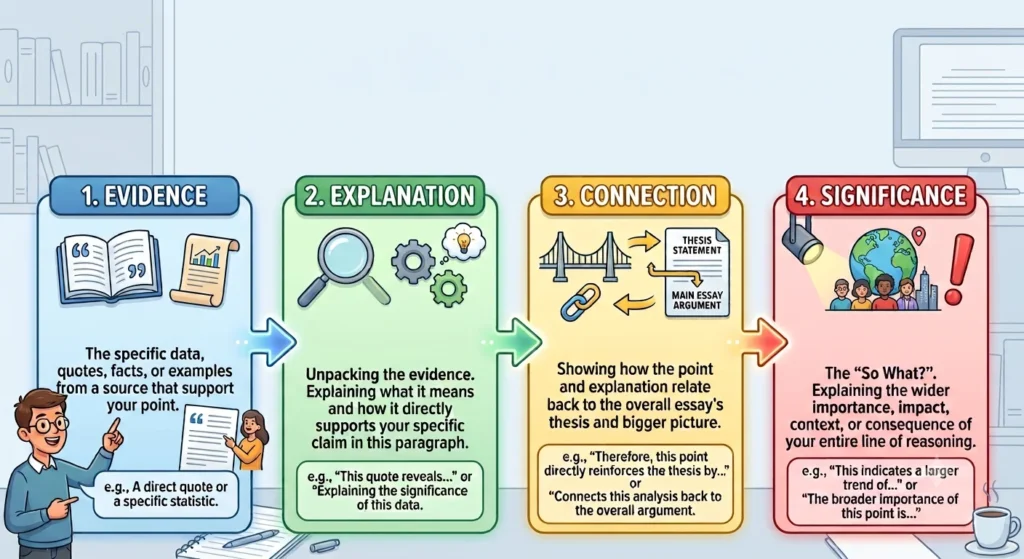
Commentary Formula:
If remembering these steps for writing a commentary is difficult for you, then here is a simple formula you can memorize for writing a strong commentary.
Commentary Essay Example
Understanding how to write a commentary becomes much easier with a real-world example. Here is a strong example that will help you write effective commentaries.
Claim: Regular physical activity improves academic performance.
Evidence: According to a study published in the Journal of School Health, students who engage in some kind of regular physical activity report better academic performance than their less-active peers.
Commentary: This evidence suggests that physical activity isn’t important only for the physical health of the students, but it also benefits them in their academics. Regular physical activity improves concentration, memory and overall cognitive functioning. Moreover, students report increased alertness levels after regular exercise. These alertness levels help students eliminate brain fog, understand their lectures and perform well in exams.
This example shows how you can write a commentary essay yourself. This is just one paragraph of an entire essay. The basic guidelines for writing the entire essay remains the same.
Conclusion
What is commentary in an essay? It is a crucial part of an essay that establishes a logical link between a writer’s claim in a paragraph and their evidence that they presented. A well-written commentary not only helps readers understand why your claim and its supporting evidence matters, but also demonstrates a strong understanding of the topic. To write a strong commentary, you need to provide an interpretation and analysis of the evidence that you presented, rather than repeating it throughout your content.
Lastly, review it for clarity after completion as the first draft usually lacks perfection. Do you think you are fully equipped to write a commentary essay yourself? Let us know in the comments.
