
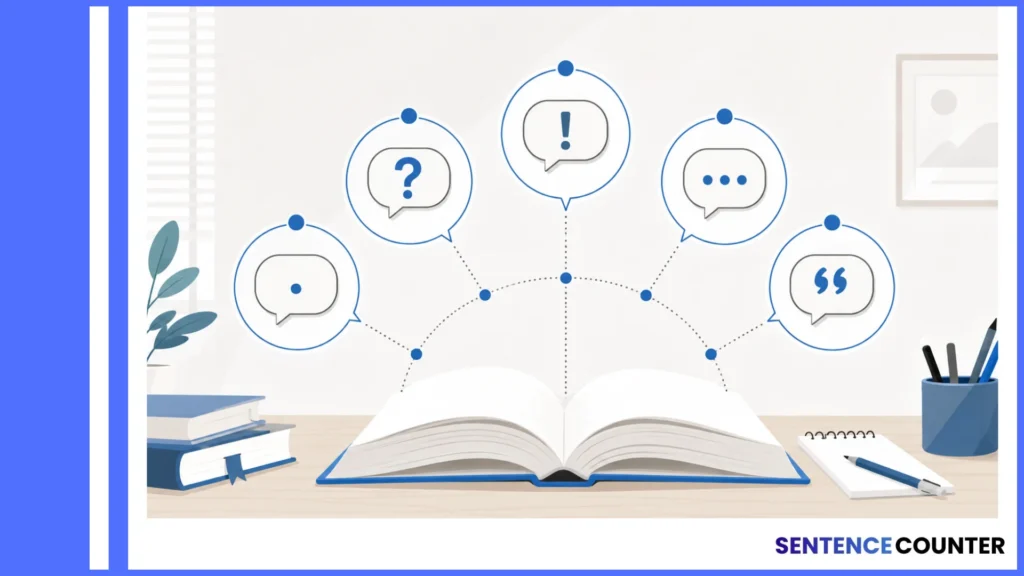
There are many different types of sentences in academic writing based on their structure and function. Structurally, the main types are:
- Simple sentence
- Compound sentence
- Complex sentence
- Compound-complex sentence
Moreover, sentence types based on their purpose are divided into
- Imperative sentences
- Declarative sentences
- Interrogative sentences
- Exclamatory sentences
This article will explore the different types of sentences in the English language with examples to help you understand how to use each sentence type correctly.
What are the 4 Types of Sentences by Structure?
Understanding the different sentence types in the English language is important for mastering it. Here are the four types of sentences by structure.
1. Simple Sentence:
A simple sentence is a type of sentence that contains only one independent clause, a single subject and a verb (or verb phrase) that together express one complete thought. Many people are often confused about the difference between an independent and a dependent clause. Therefore, the table below explains the difference between the two concepts.
| Aspect | Independent Clause | Dependent Clause |
|---|---|---|
| Definition | Contains a subject and verb and expresses a complete thought | Contains a subject and a verb but does not express a complete thought |
| Can stand alone? | Yes, an independent clause can stand alone as a complete sentence. | No, it must be attached to an independent clause |
| Starts with | No subordinating word required | Often begins with a subordinating conjunction (because, although, since, if, when, while) or a relative pronoun (who, which, that) |
| Example | She finished her homework. | Because she finished her homework |
| Role in a sentence | Forms the “main” part of a sentence | Adds extra context, condition, reason, or detail to the main clause |
| Used in | Simple and compound sentences | Complex and compound-complex sentences |
Now that you have understood the difference between an independent and a dependent clause, let’s delve a bit further into what makes a simple sentence. As explained previously, it contains one independent clause. Then, it isn’t always short. For instance, it can also include:
- Compound subjects
- Compound verbs
- Other extended modifiers
Example:
- I have completed my homework.
- My exams will be held next week.
- The exhausted marathon runner collapsed near the finish line.
2. Compound Sentence:
A compound sentence joins two or more independent clauses using a coordinating conjunction or a semicolon. Some of these conjunctions are: but, and, for, not, so, yet, or, etc.
Independently, these clauses can act as a complete sentence. But these conjunctions are used to connect two or more ideas within one sentence. Basically, a compound sentence can be referred to as a coherent combination of two or more sentences.
Examples:
- The power went out, but the backup generator turned on immediately.
- She studied all night for the exam, so she felt confident walking in.
- We could go hiking this weekend, or we could stay home and relax.
3. Complex Sentence:
A complex sentence contains one independent clause joined with at least one dependent clause separated by a comma. A dependent clause begins with a subordinating conjunction (because, although, since, when, if, while, etc.) or a relative pronoun (who, which, that) and cannot stand alone as a complete sentence.
Examples:
- Because the flight was delayed, we missed our connection.
- The book that you recommended turned out to be my favorite read this year.
- Although he was tired, he finished the report before midnight.
4. Compound-Complex Sentence:
A compound-complex sentence contains at least two independent clauses joined with at least one dependent clause. These sentences allow writers to express more nuanced relationships between multiple ideas within a single sentence.
Examples:
- Although the meeting ran late, the team finished the proposal, and everyone left satisfied with the outcome.
- She wanted to travel abroad, but she couldn’t afford it because she had just bought a new car.
- When the rain finally stopped, the children ran outside, and their laughter filled the yard.
What are the Four Types of Sentences Based on Their Purpose?
The types of sentences in English go beyond sentence structure. In formal writing, sentences are classified according to their purpose as well. Here are the most common sentences by function.
1. Declarative Sentence:
A declarative sentence expresses a definitive statement, fact, opinion, or idea. It’s the most common sentence type in everyday writing and speech, and it always ends with a period.
Examples:
- The library closes at 9 PM.
- I think this restaurant serves the best pasta in town.
- Plants need sunlight to grow.
2. Interrogative Sentence:
An interrogative sentence is a sentence that ends with a question mark. Basically, it begins with a question word such as who, what, where, when, how, or why. Additionally, these sentences use auxiliary verbs such as do, did, does, is, are, can, and will.
Examples:
- Do you think it will rain today?
- Is it possible for me to skip the meeting?
- Where is James?
3. Imperative Sentence:
An imperative sentence gives a command, makes a request, or offers instructions. It often omits the subject entirely, since the subject (“you”) is implied rather than stated. It can end with an exclamation mark or a period, depending on the tone.
Examples:
- Close the door before you leave.
- Please submit your assignment by Friday.
- Watch out for the wet floor!
4. Exclamatory Sentence:
An exclamatory sentence expresses strong emotion, surprise, excitement, anger, or urgency, and always ends with an exclamation mark.
Examples:
- I can’t believe we won the championship!
- That was the scariest movie I’ve ever seen!
- Watch out, the stove is still hot!
Conclusion
This article has explained the different types of sentences you need to learn about. Understanding the different sentence types according to their purpose and structure not only helps you sound more professional, but also makes your writing more varied, clear, and precise.
Additionally, to steer clear of overly long sentences that hurt your readability, use our Sentence Counter tool to instantly analyze the length of your sentences for improved and clear writing. Which sentence type do you find yourself using most often in your writing? Let us know in the comments.
