
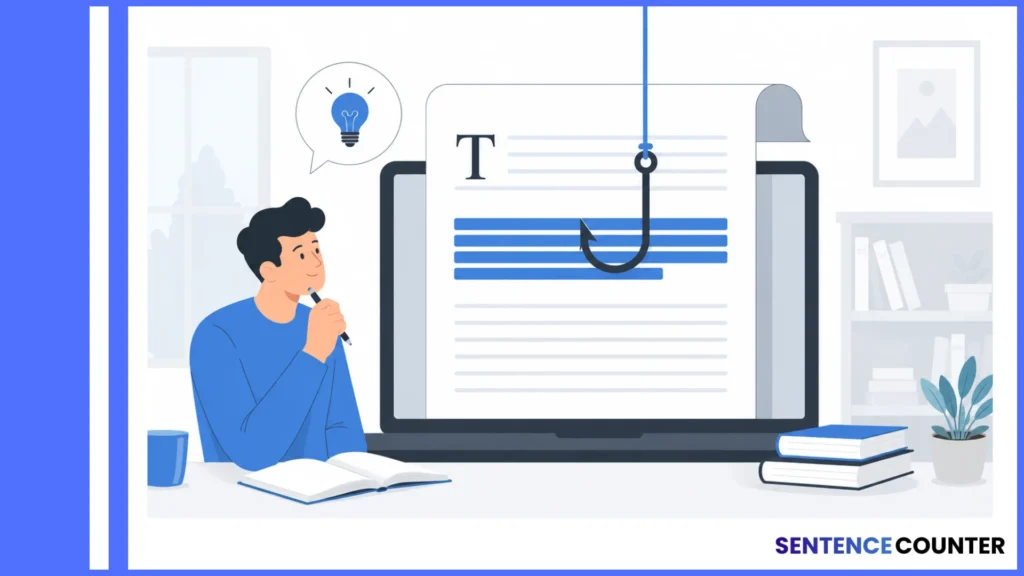
How often you come across such articles while scrolling where you read the first line and want to read more? We all have come across such pieces of writing which are just irresistible to read. Therefore, many people must have heard about hooks at some point in their lives. So, what is a hook in an essay? And, why does it matter? The truth is that the way you write the first line or sentence of your essay decides if the readers should keep reading or not.
Understanding how to begin your essay is the key to writing compelling content. Whether you’re writing a research paper, a college essay or a high school essay, first impression is always the last impression. This article will explain what a hook is, why it is used and how it connects with your readers, different types of hooks, and how to write a compelling hook yourself with examples.
What Is a Hook in an Essay & Why it Is Used?
A hook is the first sentence or the first few sentences of an essay, designed to grab a reader’s attention and make them read the whole essay. Before introducing the topic in the introduction (thesis statement), hooks are written to set the tone of the essay. Furthermore, good essay hooks give a brief overview to the readers about what to expect from the essay. Additionally, a good hook serves several purposes:
- Captures the reader’s attention immediately.
- Creates curiosity about the topic.
- Establishes the tone of the essay.
- Provides a smooth transition to the thesis statement.
- Makes the introduction more memorable.
Writing a good hook for an essay can turn even a boring content into compelling and engaging one.
What are the Most Common Types of Essay Hooks?
Hooks vary in their types and purposes. Different types of essays use different hooks. Understanding which one to use correctly ensures that your content is well-written and engaging. Here’s an overview of different types of hooks.
1. Question Hook:
A question hook engages readers by engaging a thought-provoking question right in the first sentence of your essay. Asking a question is a brutally effective method for the readers to keep reading your content, because they would want an answer to it. As a result, a question hook is used by strong writers to make their content stand out before their instructors.
Best used in:
- Argumentative essays
- Persuasive essays
- Informative or expository essays
Hook example:
How would the world react if backwards time travel became a reality?
The question above is a hook sentence example used to demonstrate how to write a compelling hook. This question alone makes readers wonder about the implications of time travel and how would the world react. So, the readers would want to read further after this hook.
2. Surprising Fact or Statistic Hook:
Using a fact or surprising stats is another effective way to write a killer hook, especially in academic writing or scientific essays. Presenting an unexpected fact is an excellent way to incite curiosity in a reader’s mind and make them follow through.
Best used in:
- Research papers
- Informative essays
- Analysis essay
Hook sentence example:
Skydiving is known to be statistically safer than driving a car .
The hook above challenges the convention perspective that if a person is falling from the sky using only a parachute, then it must be dangerous. But the example above will force the readers to read more due to a contradiction to their general idea.
Pro tip: Always cite credible sources when mentioning a fact or statistical data in your essay.
3. Quote Hook:
A quotation from a well-known personality is another great way to write a compelling hook.
Best used in:
- Literary analysis
- Reflective essays
- Education-related topics
Example:
With great power, comes great responsibility.
This hook will naturally make readers wonder what does the quote mean. And, what is the context here. So, the readers would want to read more.
4. Anecdotal Hook:
An anecdotal hook, used interchangeably with narrative hook, starts with a short, interesting story that relates to the essay’s main idea. The story you mention could be your own personal story or of someone you personally know. Keep in mind, that the story must be related to the topic of your essay. Additionally, using an anecdote in the hook helps give academic essays a personalized touch, ensuring that your content connects and resonates with your readers.
Best used in:
- Personal essays
- Narrative essays
- Scholarship essays
Example:
When Jake went 10,000 feet up in the air, his heart raced and his legs were shaking. All the time he was thinking why he volunteered for skydiving. But then he overcame his fear.
These kinds of anecdotes create a connection with the readers and add a personal touch to your overall content.
Narrative Hook vs Anecdotal Hook:
While, the purpose of both the hooks is to tell a short story or an incident, they differ slightly in their purpose. Here is the difference between them.
| Narrative Hook | Anecdotal Hook |
|---|---|
| Uses a story or scene to draw readers in. | Uses a brief personal or real-life story to illustrate a point. |
| May be fictional or based on real events. | Usually based on a real experience or true incident. |
| Focuses on creating interest and suspense. | Focuses on illustrating the essay’s main idea through an example. |
5. Bold Statement Hook:
A bold statement immediately grabs readers’ attention from the very first sentence by presenting an unexpected opinion or assertion.
Best used in:
- Opinion essays
- Persuasive essays
- Argumentative essays
Example:
Overusing AI has impacted critical thinking dramatically over the last few years.
This statement makes the readers want to understand the link between the use of AI and its impact on human intelligence.
Pro tip: Always make claims that can be definitively proved by current research or established facts. Making unreliable or misleading claims can have a negative impact in front of your readers.
“Extraordinary claims require extraordinary proof”
6. Descriptive Hook:
A descriptive hook paints a vivid picture using sensory details.
Best used in:
- Narrative essays
- Descriptive essays
- Creative writing
Example:
As the building was caught violently in flames, the smoke started rising up to the sky.
The hook above paints a vivid picture using sensory details. This kind of hook will help the readers visualize the exact scenario, as if they are there. Moreover, this hook uses relevant adverb of manner (violently) to make it more expressive. Using such adverbs can further enhance the sensory details of your essay.
List of Adverbs of Manner You Can Use:
| Category | Adverbs of Manner |
|---|---|
| Movement & Action | slowly, quickly, rapidly, suddenly, gradually, steadily, swiftly, gently, silently, cautiously |
| Intensity & Force | violently, fiercely, powerfully, heavily, wildly, strongly, sharply, forcefully, desperately, intensely |
| Sound | loudly, softly, quietly, noisily, faintly, clearly, cheerfully, angrily, nervously, excitedly |
| Appearance & Beauty | beautifully, gracefully, elegantly, brightly, brilliantly, vividly, magnificently, delicately, perfectly, artistically |
| Emotion | happily, sadly, anxiously, nervously, joyfully, angrily, calmly, confidently, fearfully, hopelessly |
| Nature & Weather | gently, fiercely, relentlessly, peacefully, steadily, continuously, violently, softly, heavily, endlessly |
| Mystery & Suspense | eerily, strangely, mysteriously, secretly, cautiously, silently, unexpectedly, suddenly, quietly, ominously |
| Determination & Effort | bravely, tirelessly, diligently, carefully, patiently, faithfully, eagerly, relentlessly, persistently, confidently |
7. Historical Hook:
Depending your essay topic, you can also mention a historical incident or fact to make it more contextually relevant.
Best used in:
- History essays
- Research papers
- Informative writing
Example:
In 1961, Yuri Gagarin became the first man to successfully go to space. This started a global space race between USA & USSR as the two countries competed for global political, technological and economic domination.
The example above highlights the past geopolitical events between USA & USSR in a slightly dramatic tone. From this point, readers would want to learn exactly what happened. How the USA won the space race even when USSR had the upper hand.
8. Definition Hook:
A definition hook explains an important concept before discussing it.
Best used in:
- Informative essays
- Academic writing
- Explanatory essays
Example:
Spotlight effect is a cognitive bias where some people think that people pay very close attention to their words, while in reality they might remember only 10% of the entire conversation.
The hook above perfectly explains a complex cognitive phenomena in simpler and short words, making it easy for the readers to follow through.
9. Contradiction Hook:
This hook presents two apparently opposing ideas, encouraging readers to understand their link.
Best used in:
- Argumentative essays
- Analytical essays
- Social issue essays
Example:
The more connected we become through technology, the lonelier many people feel.
The hook above will be relatable for many readers, creating immediate interest in the essay.
10. Scenario or “Imagine” Hook:
Building a fictional or hypothetical scenario is a great way to induce curiosity among readers. With this type of hook, the readers are able to visually imagine themselves in that situation.
Best used in:
- Persuasive essays
- Technology topics
- Future-focused discussions
Example:
Suppose that you wake up tomorrow only to realize that everyone around you is acting strange. What would you do?
The hook above creates an immersive scenario for the readers, making the content compelling and interesting.
How to Write a Hook in an Essay?
Writing an effective hook is all about inducing curiosity among your readers. To do this, first you will need an in-depth understanding of the essay topic. Then, you will need to focus on keeping the hook as concise as possible, rather than write a long speech. Depending on your essay type, you can use a thought-provoking question, a surprising fact, a relevant quote, a brief anecdote, or a vivid description. Additionally, make sure that the hook naturally transitions into your thesis statement, establishing a logical and coherent link between that single sentence or multiple sentences and the core topic of your essay.
Conclusion
What is a hook in an essay? It is the most important part of your essay that captures your readers’ attention and force them to read further. Additionally, a well-written hook demonstrates strong writing skills. Furthermore, depending on the type, topic and audience of your essay, you can begin with a quote, a fact or a statistic or a short story that sparks curiosity among your readers. Finally, a well-written hook will make your essay unforgettable for your readers. What’s your favorite way to start an essay with a hook? Share your thoughts in the comments below.
FAQs
1. What should you avoid when writing an essay hook?
Avoid generic statements, unrelated quotes, inaccurate statistics, and overly broad openings. Your hook should be specific and directly connected to the essay topic.
2. Can a hook be more than one sentence?
A one-sentence hook is ideal for academic essays. But if required, you may write 2-3 sentence-hook to spark curiosity among your readers.
3. Where does the hook go in an essay?
A hook is the first line of your essay. So, it appears right at the start of your essay’s introduction.
