
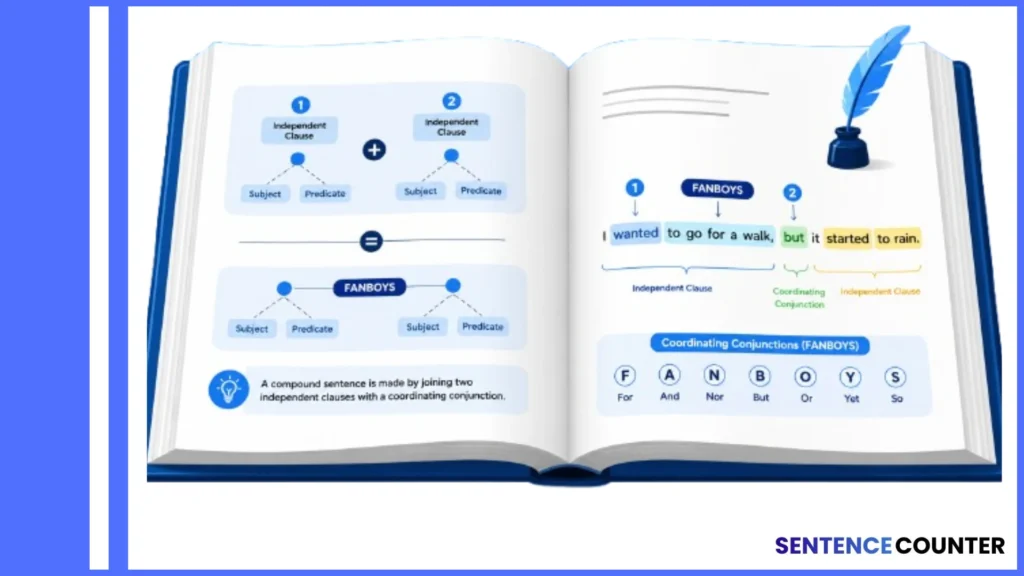
One of the most common types of sentences is a compound sentence. It is used to combine two different ideas or thoughts in one sentence. Unlike simple sentences, which express one idea per sentence, a compound sentence allows you to connect two ideas naturally in a sentence. This article will explain what a compound sentence is, its structure, and some examples, so that you can master this sentence type.
Compound Sentence
In the English language, a compound sentence is a sentence that combines two or more independent clauses, without any dependent clauses. An independent clause is a group of words that expresses a complete thought. It contains a subject and a verb.
Furthermore, it can stand alone as a complete idea, eliminating the need to add a dependent clause. Additionally, compound sentences help in connecting related ideas smoothly, adding more clarity and coherence in your writing.
Example:
- It is raining today.
- I went to the park yesterday.
The examples above are independent clauses. They express a complete idea and therefore act as a foundation of a compound sentence. Generally, a compound sentence contains two clauses. But they can also contain more than two clauses as well.
Compound Sentence Structure:
Generally, writers use a variety of sentence structures to make compound sentences, which are given below:
- With a comma
- With a semicolon (;)

In the first structure, compound sentences contain a comma followed by a coordinating conjunction. You must have heard about the acronym FANBOYS. This is the structure where they are used. This acronym is:
- F – For
- A – And
- N – Nor
- B – But
- O – Or
- Y – Yet
- S – So
Example:
- My name is John, and I study in 5th grade.
In the 2nd structure, writers usually place a semicolon without any conjunctions.
Example:
- My name is John; I study in 5th grade.
In the above examples, you can see that these two can act on their own as complete sentences.
- My name is John.
- I study in 5th grade.
We combined these two simple sentences into one simply by adding relevant punctuation and adding or removing conjunctions. Another popular way to write compound sentences is to use conjunctive adverbs (however, moreover, therefore, furthermore, etc).
Example:
- You didn’t complete your homework; moreover, you are late today.
Take a look at the punctuation rules if you are using this alternative method for writing compound sentences. Generally, you write the first independent clause. After that, you include a semicolon followed by a conjunctive adverb and a comma.
Compound Sentence Examples
In the examples below,
- The subject is highlighted in blue.
- The verb is highlighted in black.
- Coordinating conjunctions are highlighted in red.
- Conjunctive adverbs are highlighted in green.
Making it easier for you to distinguish the different sentence structures demonstrated in these examples.
1. Present Simple Tense:
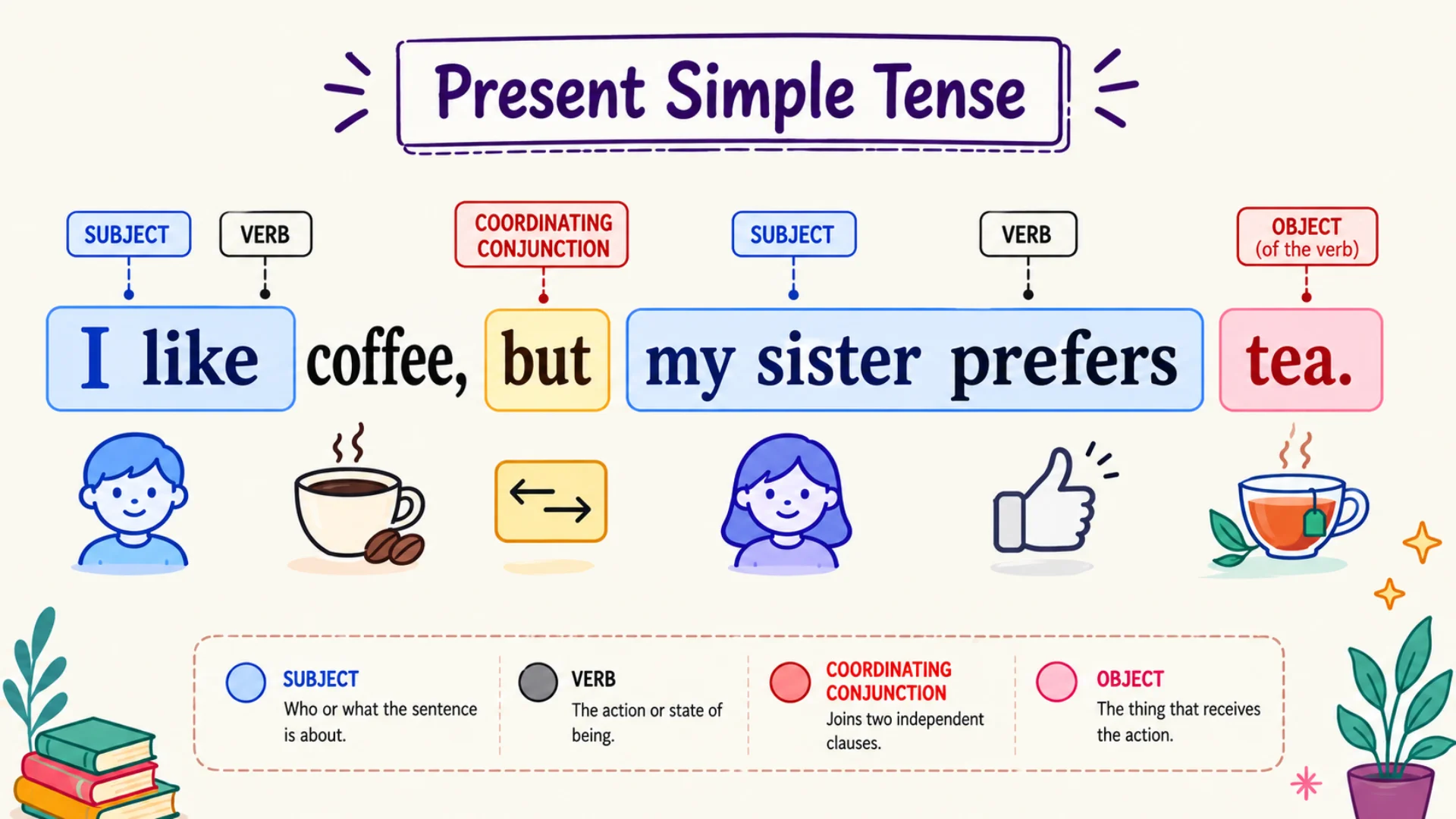
- I like coffee, but my sister prefers tea.
- He works in Ohio, and his wife teaches in New York.
- She doesn’t eat meat; she follows a vegetarian diet.
- Either you finish the report, or someone else takes over the task.
- He studies every morning; therefore, he performs well in exams.
2. Past Simple Tense:
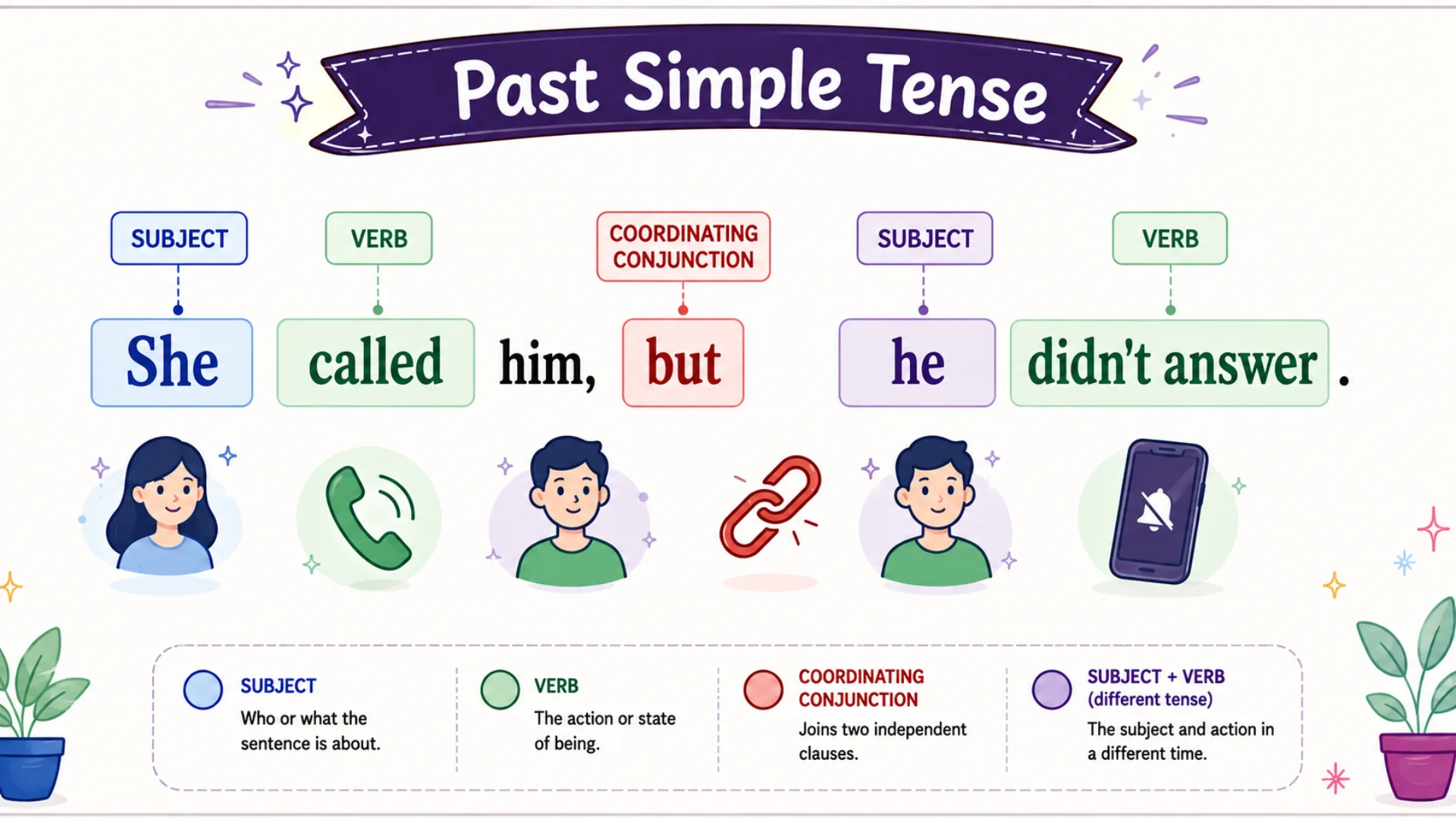
- She called him, but he didn’t answer.
- The rain stopped, and the sun came out.
- He missed the bus; he arrived late to the office.
- They didn’t like the movie, nor did they recommend it to others.
- She lost her keys; consequently, she couldn’t enter the house.
3. Future Simple Tense:
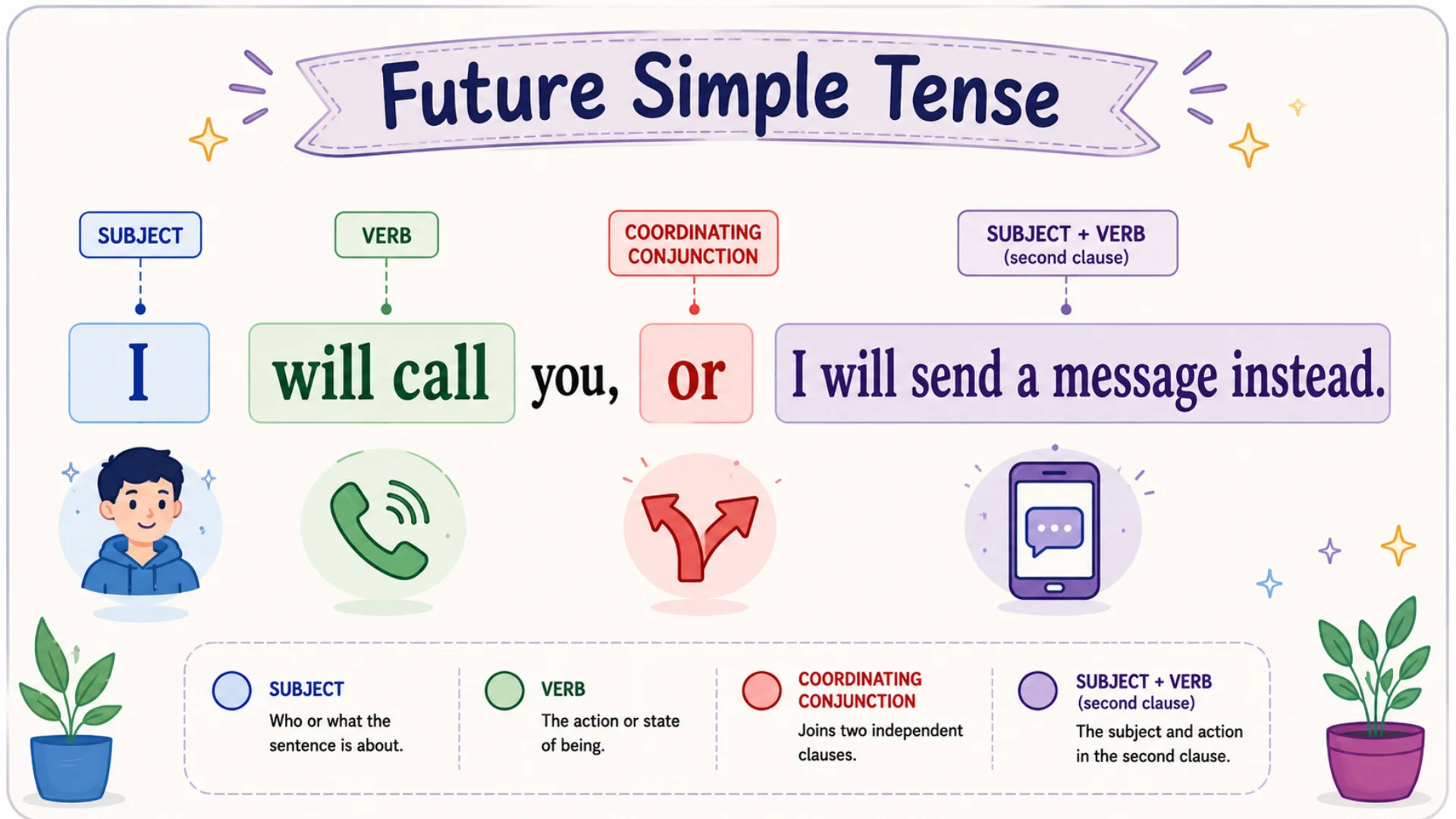
- I will call you, or I will send a message instead.
- She will finish the project, and her team will present it on Monday.
- He won’t attend the meeting; he will join remotely instead.
- They will travel to Islamabad, but they won’t stay for long.
- We will submit the application; therefore, we will receive a confirmation soon.
4. Present Perfect Tense + Another Tense:
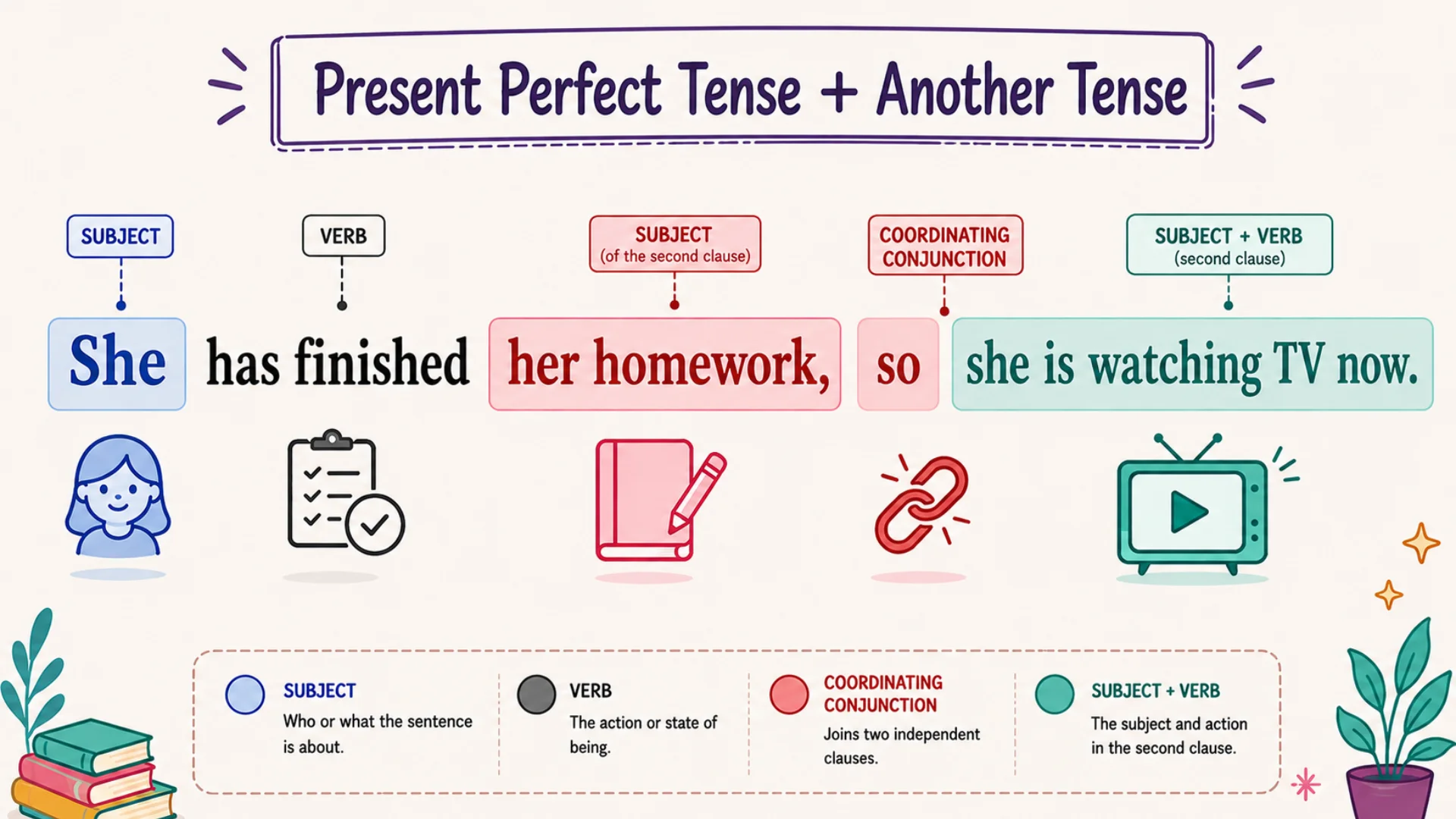
- She has finished her homework, so she is watching TV now.
- He has lived in San Francisco for ten years, and he knows the city well.
- They have already eaten; they aren’t hungry right now.
- I have completed the report, but I haven’t sent it yet.
- She has studied hard; therefore, she feels confident about the exam.
5. Mixed Tenses:
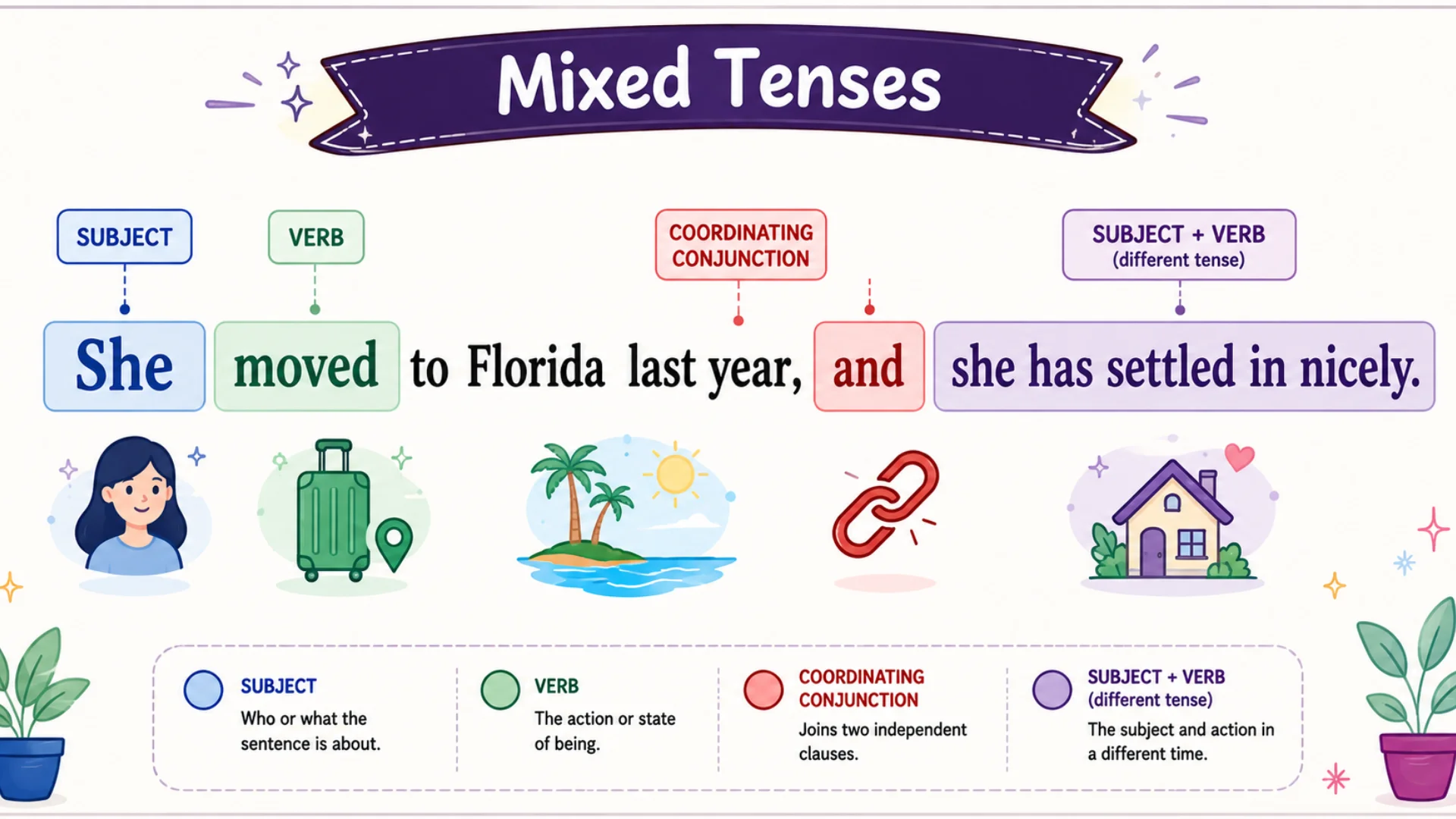
- She moved to Florida last year, and she has settled in nicely.
- He was working late, but he still finished the assignment on time.
- They had already left when the meeting started.
- I didn’t know the answer, so I am researching it now.
- She will visit her parents once she finishes her exams.
Conclusion
This article has explained what compound sentences are and how to write them in different tenses using a lot of examples. Compound sentences are pretty important to connect two or more ideas seamlessly in one sentence. They make your writing clearer and more professional. Typically, they can be written with a comma followed by a coordinating conjunction (and, so, for, nor, but, yet, or) or conjunctive adverbs such as (therefore, moreover, etc).
If you don’t wish to include these adverbs or conjunctions, you could drop the comma and add a semicolon (;) instead. Finally, mastering the compound sentences is important for clear and effective communication. Which is the easiest part of a compound sentence? Let us know in the comments below.
