
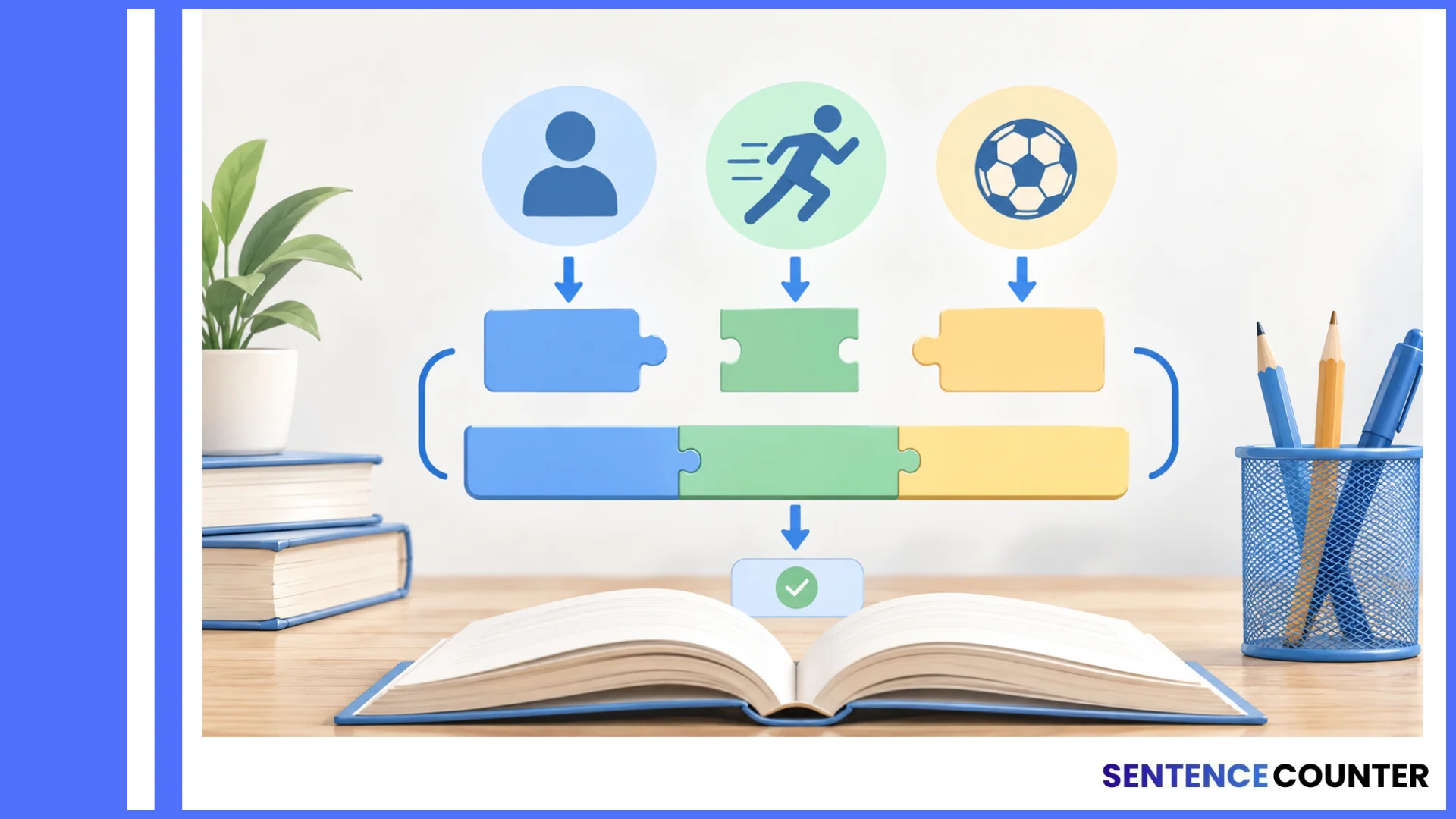
One of the most commonly used sentences in the English language is the simple sentence. It is the foundational block of all sentences, containing one independent clause without any dependent clauses. However, many people confuse these sentences with other types of sentences such as:
- Compound sentence
- Complex sentence
- Compound-complex sentence
But they are the most basic types of sentences that almost anyone can learn in no time, no matter the type of tense. This guide will explain what a simple sentence is, its function, how to write it, and some examples for different types of tenses.
What is a Simple Sentence?
A simple sentence is a sentence that contains only one independent clause. It typically contains one subject and one verb, making a complete sense without relying on dependent clauses. Depending on where you use simple sentences, they could also contain compound subjects (more than one subject) and remain a simple sentence.
Example:
- The sky is blue.
- Birds are chirping.
Additionally, they connect a subject and a predicate to communicate a complete idea. Moreover, simple sentences are not all that simple. For instance, they could also include direct objects, modifiers, or even prepositional phrases to provide more details, while remaining an independent clause.
For example, in the sentence “The young boy kicked the ball across the field,” “the ball” is the direct object, “young” is a modifier describing the boy, and “across the field” is a prepositional phrase that explains where the action happened.
Function of a Simple Sentence Structure
A simple sentence serves as the building block of clear and effective communication. These sentences are easier to understand because they contain one idea per sentence without lengthening the sentence significantly.
Additionally, readers can quickly identify the main idea from the sentence because they contain only one independent clause. Here are some reasons why you should use this sentence structure more often.
1. Improves Readability:
Due to their single-clause structure, they are the easiest to read in long paragraphs. Additionally, they help readers process the information more quickly because they contain one idea per sentence.
For example:
- It is raining outside.
- This computer is expensive.
- James and Edward will be back in a moment.
2. Emphasizes Important Ideas:
As these sentences usually span up to a single line, they don’t combine more than one idea in a single line. This eliminates extra information from the sentence, directing your focus only to the most important part.
For example:
- Jack has failed the exams.
- Jason is a bit under the weather.
3. Prioritizes Simplicity:
Compound complex, compound, or complex sentences are usually used to add more detail, but if your focus is simplicity, then go for simple sentences. These sentences are the easiest to understand for readers.
4. Forms the Building Block of Longer Sentences:
This type of sentence can be transformed into more advanced types such as compound, complex, or compound-complex sentences. Writers can combine two simple sentences or more than two of them using coordinating conjunctions to form compound sentences or add dependent clauses to create complex sentences.
For example:
- Simple sentence: “It was raining outside.” “We stayed at home.”
- Compound sentence: It was raining outside, so we stayed at home.
- Complex sentence: We stayed at home because it was raining outside.
How to Compose a Simple Sentence?
To compose a simple sentence, start with the basics of grammar. It is a sentence that contains one independent clause and must contain a subject and a verb that form a complete thought. In other words, it consists of one independent clause, or simply, a sentence consists of one independent idea that can stand on its own as a complete sentence.
Next, choose whether to add a direct object, complement, modifier, or prepositional phrase to communicate your idea more effectively. A simple sentence can have a compound subject or a compound verb joined by a coordinating conjunction, provided it still contains only one independent clause.
An example of a simple sentence is
“The teacher explained the lesson.”
Other examples of simple sentences include:
- “Birds build nests.”
- “Emma baked a cake.”
When comparing simple sentences vs other four sentence structures, remember that whereas a simple sentence contains one independent clause, a compound sentence has at least two independent clauses joined by a coordinating conjunction. Understanding these differences helps you vary your writing, coordinate ideas appropriately, and write stronger paragraphs or an essay.
30 Simple Sentence Examples
1. Past Simple Tense Examples:
Note: The subject is highlighted in blue, and the verb is highlighted in black.
- She visited her grandparents last weekend.
- The children played in the park yesterday.
- We watched a movie after dinner.
- David finished his homework before bedtime.
- They traveled to Australia last summer.
- The teacher explained the lesson clearly.
- My brother repaired the bicycle yesterday.
- I cooked dinner for my family.
- Sarah cleaned her room before lunch.
- The dog chased the ball across the yard.
2. Present Simple Tense Examples:
- She drinks coffee every morning.
- Birds fly south during winter.
- The Earth revolves around the Sun.
- My father works in a hospital.
- We study English every day.
- The train arrives at eight o’clock.
- Emma enjoys reading novels.
- Dogs bark when they hear strangers.
- The students complete their assignments on time.
- My sister plays the piano every evening.
3. Future Simple Tense Examples:
- I will call you this evening.
- They will visit the museum tomorrow.
- She will finish the project next week.
- We will celebrate your birthday together.
- The team will play on Saturday.
- My parents will arrive tonight.
- He will buy a new laptop next month.
- The meeting will begin at 10 a.m.
- The children will enjoy the school trip.
- Our neighbors will move into their new house next month.
To Sum Up
Simple sentences are the foundation every writer builds on. By pairing a single subject with a single verb, they let you state one idea clearly, without the added weight of dependent clauses. Whether you’re writing in the past, present, or future tense, mastering simple sentences will sharpen your writing and make your ideas easier for readers to follow.
And once you’re comfortable using them, you’ll find it easier to combine them into compound, complex, and compound-complex sentences whenever your writing calls for more detail or nuance.
