
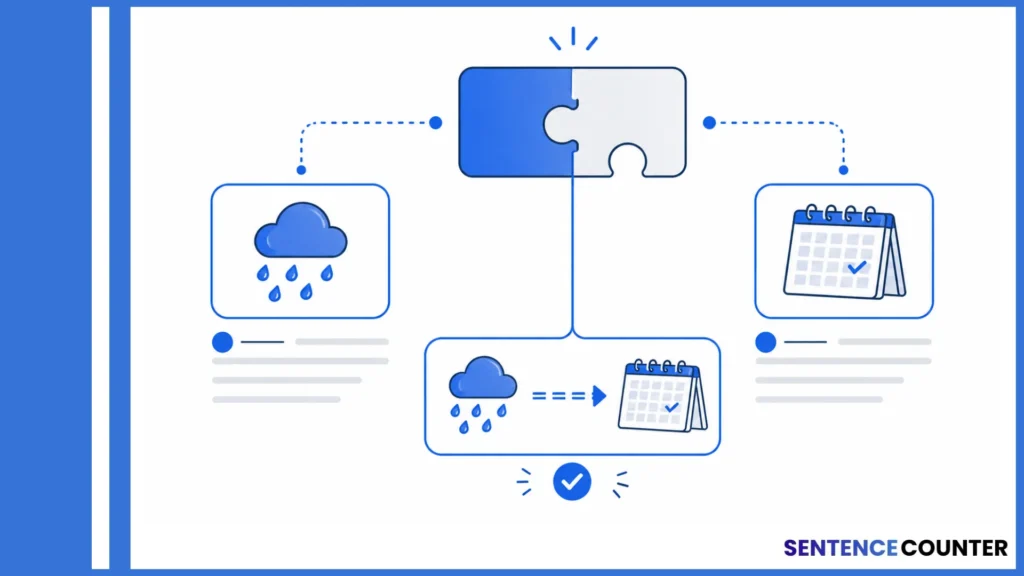
Complex sentences are one of the most commonly used types of sentences in the English language by writers. They are used to express relationships between ideas with greater depth and precision. A complex sentence contains two clauses, joining the main clause with additional information and context to add more detail.
They are commonly used in everyday communication to explain causes, conditions, compare and contrast, and reasons and relationships between events. This article will explain the structure of a complex sentence along with relevant examples to help you understand how to use them effectively.
What is a Complex Sentence?
A complex sentence is a sentence that contains one independent clause and at least one dependent clause together. The independent clause expresses a complete thought and can stand alone as a complete sentence. On the other hand, a dependent clause relies on an independent clause to make sense completely. Both clauses contain a subject and a verb.
Complex Sentence Structure
The dependent clause is connected to its supporting independent clause with a subordinating conjunction (because, although, when, if, etc.). A complex sentence can generally be written in three ways, which are explained below.
1. Independent Clause + Dependent Clause:
In this structure, a complex sentence starts with an independent clause and ends with a dependent clause. A subordinating conjunction connects the dependent clause to the main clause.
Example:
I stayed at home because it was raining.
In this example, the independent clause (I stayed at home) at the start is connected with a dependent clause using a subordinating conjunction in between.
2. Dependent Clause + Independent Clause:
Another common structure for writing complex sentences effectively is to put the dependent clause at the start and the independent clause at the end. In this kind of structure, subordinating conjunctions are usually replaced with a comma when transitioning between clauses.
Example:
Because it was raining, I stayed at home.
The dependent clause (because it was raining) comes at the start of the sentence. And the independent clause comes at the end. Note that both the clauses in this structure are connected with a comma.
3. Independent Clause + Relative Clause:
A complex sentence can also contain a relative clause, which provides additional information about a noun or pronoun in the independent clause. Relative clauses are commonly introduced by relative pronouns such as who, whom, whose, which, and that.
Example:
The woman who lives next door is a doctor.
“The woman is a doctor” forms the independent clause, while “who lives next door” is a dependent relative clause. The relative pronoun who connects the additional information to the noun “woman.”
Subordinating Conjunctions:
Subordinating conjunctions help you connect ideas seamlessly in complex sentences. They are used to describe the relationship between an independent and a dependent clause. Additionally, they can express factors such as time, conditions, contrast, purpose, and cause-and-effect relationships. Here are some of the most commonly used conjunctions in English grammar.
- because
- as
- since
- although
- unless
- once
- when
- where
- before
- whenever
- wherever
- until
- provided that
- than
- after
- so that
Using the correct subordinating conjunction helps the readers understand the exact relationship between the two clauses.
Examples:
- I will call you when I arrive home early.
- I will call you if I arrive home early.
Both are complex sentences, but differ in their meanings. The first sentence represents certainty that the person will arrive home early, so they will make the call then. Whereas the second example highlights a possibility that if they arrive home early, they will make the call. So, using the correct conjunction helps make your writing clearer and free of any errors.
Difference Between a Complex Sentence and a Compound Sentence
| Type of sentence | Definition | Example |
| Compound Sentence | A compound sentence contains two or more independent clauses joined by a coordinating conjunction (for, and, nor, but, or, yet, so). | I stayed at home, and I watched a movie. |
| Complex Sentence | A complex sentence contains an independent clause and at least one dependent clause, joined by subordinating conjunctions such as: because, although, since, so, etc.) | I stayed at home because it was raining. |
Difference Between a Complex Sentence and a Simple Sentence
| Type of sentence | Definition | Example |
| Simple Sentence | A simple sentence is the most basic type of sentence in speech or writing. It contains a single independent clause. | I was playing cricket. |
| Complex Sentence | A complex sentence contains an independent clause and at least one dependent clause, joined by subordinating conjunctions such as: because, although, since, so, etc.) | I stayed at home because it was raining. |
30 Complex Sentence Examples
In the examples below,
- The subject is highlighted in blue.
- The verb is highlighted in black.
- Subordinating conjunctions are highlighted in red.
This will make it easier for you to distinguish the different parts of a sentence in these examples.
Simple Present Tense:
- I drink coffee because I need energy in the morning.
- Although the weather is hot, we enjoy walking outside.
- The teacher who teaches English explains grammar clearly.
- She reads books whenever she has free time.
- Because he works from home, he saves time on commuting.
Simple Past Tense:
- I stayed at home because it rained all day.
- Although she felt tired, she finished her assignment.
- The restaurant that opened last month quickly became popular.
- When the movie ended, everyone left the theatre.
- He missed the bus because he woke up late.
Future Tenses:
- I will call you when I arrive home.
- Although the project is difficult, we will complete it on time.
- The company that launches the new product will attract more customers.
- When the meeting ends, I will send you the report.
- She will visit her family after she finishes her exams.
Continuous Verb Tenses in the Independent Clauses:
- I am studying because I have an exam tomorrow.
- Although it was raining, the children were playing outside.
- The students who are preparing for the exam are studying in the library.
- She will be working when you arrive at the office.
- While the manager is speaking, the employees are taking notes.
Mixed Verb Tenses:
- I am learning English because I want to improve my writing skills.
- Although she was tired, she is completing the project today.
- The man who works at the bank will help you when you arrive.
- When I finish my work, I will be watching a movie with my friends.
- She had finished her assignment before the teacher asked for it.
Conditional Sentence Examples:
- If you study regularly, you will improve your grades.
- I would travel more if I had enough money.
- If it rains tomorrow, we will stay at home.
- The students who complete their assignments on time will receive extra credit if the teacher approves it.
- Although he would accept the offer if the salary were higher, he has not made a decision yet.
Conclusion
Using complex sentences helps writers engage readers more effectively by presenting two or more ideas in a single sentence. They also help relate different ideas by showing relationships such as cause and effect, time, condition, and contrast. By understanding how dependent and independent clauses work together, you can ensure more professional and clearer writing.
Additionally, punctuation is also an important factor depending on the particular sentence structure you use. Furthermore, complex sentences add variety to your writing and make your sentences more informative and effective. With regular practice, complex sentences can help you express detailed ideas without making your writing difficult to understand.
