
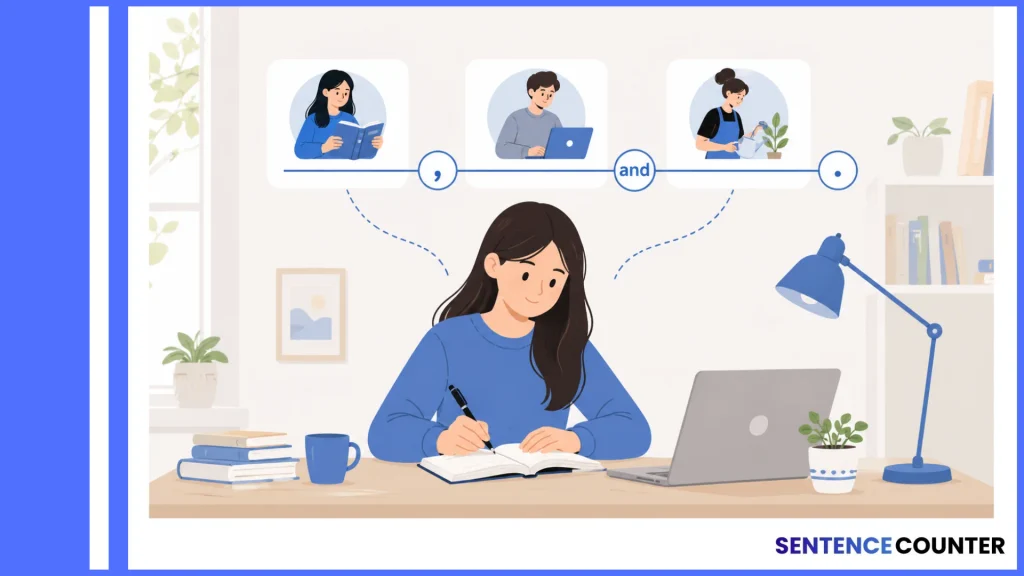
Connecting multiple ideas effortlessly in a single sentence is one of the key benefits of a compound complex sentence. These types of sentences enable us to show several ideas, explain their relationships, or add important details.
This article will explain the definition of a compound-complex sentence, along with the sentence structure you need to follow and some examples to help you master this sentence type.
What is a Compound Complex Sentence?
A compound complex sentence consists of two or more independent clauses and one or more dependent clauses. It combines features of a compound sentence and a complex sentence structure. Each independent clause expresses a complete thought and can stand alone as a sentence.
Meanwhile, a dependent clause cannot stand alone because it needs another clause for meaning. Additionally, these clauses connect through a coordinating conjunction, subordinating conjunction, or relative pronoun. This type of sentence helps writers combine related ideas while maintaining clarity and logical relationships.
Practice What You Learn:
Want to practice identifying and writing compound-complex sentences? Download our free compound complex sentences worksheet with clause exercises, conjunction practice, punctuation questions, sentence-building activities, and an answer key.
Compound Complex Sentence Structure
1. Dependent Clause First, Then Two Independent Clauses:
When a dependent clause begins the sentence, place a comma before the first independent clause.
Example:
“Although Maya studied hard, she felt nervous, but she completed the exam.”
Here, “Although Maya studied hard” forms the dependent clause and cannot stand alone. Meanwhile, “she felt nervous” and “she completed the exam” are two independent clauses. The coordinating conjunction but connects both independent clauses and completes the sentence structure.
2. Independent Clause, Dependent Clause, Then Independent Clause:
A compound-complex sentence can place a dependent clause between two independent clauses.
Example:
James finished his homework because he wanted free time, and he watched television.
Here, “James finished his homework” provides the first main clause of the sentence. The phrase “because he wanted free time” acts as the dependent clause explaining James’s reason. Finally, “he watched television” supplies another independent clause connected with and.
3. Two Independent Clauses First, Then the Dependent Clause:
Writers can place two independent clauses before adding a dependent clause afterward.
Example:
Sarah cooked dinner, and Tom prepared the table while their guests arrived.
In this example, “Sarah cooked dinner” and “Tom prepared the table” are independent clauses. The coordinating conjunction and connects those clauses, while “while their guests arrived” adds dependent information. Therefore, the sentence combines a compound structure with a dependent clause naturally.
4. Dependent Clause Embedded Inside One of the Independent Clauses:
A dependent clause can appear within an independent clause rather than appearing separately.
Example:
The teacher, who explained the lesson clearly, answered every question from students.
Here, “who explained the lesson clearly” functions as a relative dependent clause. The remaining words form an independent clause expressing a complete idea and showing the main action. Commas separate the nonessential dependent clause from the surrounding independent clause for clarity.
5. Multiple Dependent Clauses With Two Independent Clauses:
Some compound-complex sentences contain multiple dependent clauses alongside two independent clauses.
Although Mia was tired because she worked late, she finished her project, and she submitted it.”
“Although Mia was tired” and “because she worked late” function as dependent clauses. Meanwhile, “she finished her project” and “she submitted it” are two independent clauses. The conjunction and joins the independent clauses, while the dependent clauses provide additional reasons and context.
Coordinating Conjunctions:
Coordinating conjunctions act as connectors when independent clauses join with dependent clauses. Depending on the complexity of the sentences, coordinating conjunctions help in establishing a logical flow between the different parts of a compound-complex sentence. Here is a list of all the coordinating conjunctions used in these sentences:
- F- For
- A- And
- N- Nor
- B- But
- O- Or
- Y- Yet
- S- So
Together, this creates an acronym called the “FANBOYS” commonly used in English grammar. This acronym helps you remember which conjunctions to use between independent clauses and dependent clauses.
Subordinating Conjunctions:
Subordinating conjunctions are used for the same reason as coordinating conjunctions. They connect independent and dependent clauses. The only difference is that subordinating conjunctions can add more detail in different parts of a sentence, such as showing cause and effect between clauses or the time of a specific action. Here is a list of some of the most commonly used subordinating conjunctions:
- Because
- Although
- When
- Since
- If
- Unless
- Whenever
- Before
- After
- Whereas
- Though
These are some of the most commonly used subordinating conjunctions in compound-complex sentences.
Punctuation Rules for Compound-Complex Sentences
Punctuation helps readers separate independent clauses from dependent clauses clearly. These rules also prevent a compound-complex sentence from becoming confusing or incomplete. Accordingly, you should place commas, semicolons, and other punctuation when writing a compound-complex sentence according to clause relationships.
Joining Independent Clauses:
- Use a comma before using a coordinating conjunction when joining independent clauses together.
- Use a semicolon when two independent clauses connect closely without a coordinating conjunction.
Example:
Maria finished her homework, and she went outside because the weather improved.
Here, “and” joins two independent clauses, while “because the weather improved” forms one dependent clause. A semicolon could replace “and” when the relationship remains clear between both independent clauses.
Adverbial Clauses:
- Place a comma after an introductory adverbial clause before the main clause.
- Usually, omit the comma when an adverbial clause follows the main clause directly.
Example:
Because Liam arrived early, he prepared the room, and his assistant arranged the chairs.
The comma separates the introductory subordinate clause from the first main clause clearly. However, “Liam prepared the room because he arrived early, and his assistant arranged the chairs” needs no comma after “early.”
Relative Clauses:
- Use commas around nonessential relative clauses that provide additional information.
- Generally, omit commas when a relative clause identifies the noun being discussed.
Example:
The teacher, who prepared extra exercises, helped students, and the class finished early.
The relative clause “who prepared extra exercises” adds information but does not identify the teacher. Therefore, commas separate this clause while the coordinating conjunction connects the independent clauses.
Why You Should Use Compound-Complex Sentences?
Compound-complex sentences allow writers to connect several related ideas without creating separate, repetitive sentences.
- Coherence: These sentences show relationships between ideas, making paragraphs flow more naturally.
- Sophistication: Writers can combine causes, contrasts, conditions, and additional information within one complete sentence.
- Variety: Using different sentence structures prevents writing from sounding repetitive or mechanical.
- Clarity: Properly connected clauses can explain detailed ideas while maintaining a logical structure.
- Efficiency: Writers can communicate several connected thoughts without producing numerous short sentences.
Additionally, this structure can help students create more mature and effective academic writing.
30 Compound Complex Sentence Examples
In the examples of compound-complex sentences below:
- The subject is highlighted in blue.
- The verb is highlighted in black.
- Subordinating conjunctions are highlighted in red.
- Coordinating conjunctions are highlighted in green.
This will make it easier for you to distinguish between different parts of a compound complex sentence.
1. Simple Present Tense:
- Although Maya studies every evening, she finishes her assignments, and her brother checks them afterward.
- Daniel plays soccer after school, but he rests when his coach notices his tiredness.
- Sarah teaches English, and her students participate actively because she explains every grammar rule clearly.
- When the bell rings, James closes his laptop, and he leaves the classroom quietly.
- Emma reads novels that inspire her, and she writes reviews whenever she has enough time.
- Tom prepares dinner because his parents work late, and his sister sets the table.
2. Simple Past Tense:
- Although Liam felt nervous, he delivered his speech, and his classmates applauded loudly.
- Maria visited the library, but she returned home when the storm became stronger.
- James completed his project, and Sarah presented it because the teacher requested extra examples.
- When the movie ended, we discussed the story, and everyone shared their favorite scene.
- Olivia bought a jacket that looked expensive, but she chose it because winter had arrived.
- David cleaned the kitchen while his parents rested, and his sister washed the dishes.
3. Simple Future Tense:
- Although Emma will feel tired, she will finish the report, and her partner will review it.
- Daniel will attend the meeting, but he will leave early when his manager approves.
- Sarah will prepare the presentation, and Tom will organize the notes because everyone needs clear information.
- When the guests arrive, we will serve dinner, and the children will play outside.
- Mia will choose a course that matches her interests, and she will enroll when registration opens.
- James will call his friend after work, and they will travel together if tickets remain.
4. Present Perfect Tense:
- Although Nina has practiced daily, she has improved quickly, and her teacher has noticed.
- Michael has finished his homework, but he has waited outside because his friends are late.
- Sarah has completed the assignment, and Tom has submitted it because the deadline has arrived.
- When the team has finished training, the coach has reviewed their progress, and players have recorded feedback.
- Emma has bought a laptop that suits her needs, and she has installed the programs she requires.
- David has cleaned the office because visitors have arrived, and his colleague has arranged the chairs.
5. Past Perfect Tense:
- Although Maria had studied thoroughly, she had forgotten one formula, and her teacher had explained it again.
- James had finished dinner, but he had stayed inside until the rain had stopped.
- Sarah had packed her bags, and Tom had locked the house because they had planned everything earlier.
- When the guests had arrived, we had prepared the room, and everyone had taken their seats.
- Olivia had chosen a dress that matched the theme, and she had ordered accessories before the party began.
- David had cleaned the garage while his parents had organized boxes, and his brother had labeled everything.
Conclusion
A compound complex sentence brings multiple related ideas together while keeping the writer’s meaning organized and easy to follow. Its different patterns give writers flexibility when presenting causes, conditions, contrasts, timing, and additional information in one sentence. Proper punctuation also keeps these longer sentences readable and prevents confusion caused by incorrectly connected ideas.
Meanwhile, practicing varied examples helps students recognize patterns and apply this sentence form confidently in their writing. Ultimately, using this structure appropriately adds variety, precision, and smoother flow without making the overall writing difficult to read.
