
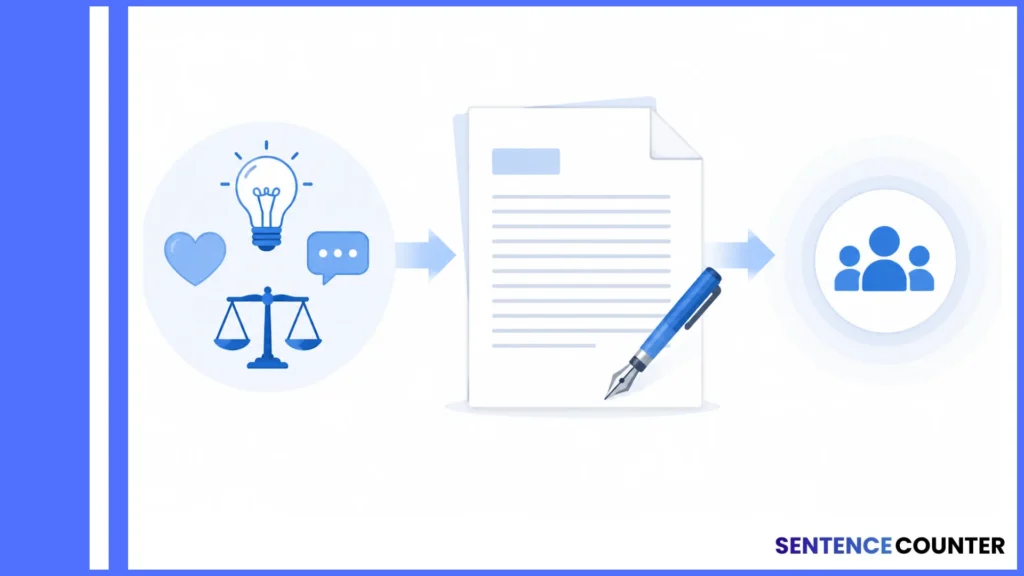
What is a persuasive essay? Persuasion is the hardest part of academic writing. Presenting your viewpoints to hundreds of readers and convincing them that your perspective is the most informed one is not easy. That’s where a persuasive essay comes in. Persuasive essays are specifically written to influence readers through words.
An essay writer presents their main argument and proves them with evidence, while refuting any opposing viewpoint. This article will explain the concept of persuasive essays and the core techniques used for writing them, with examples.
What is a Persuasive Essay?
A persuasive essay, or an argumentative essay, is any written work that tries to convince readers that the writer’s viewpoint is the correct one. Some of the most common types of essays provide information on a particular topic or narrate something.
But this essay persuades the readers to accept the author’s point of view or take a particular action, leaving a lasting impression on their readers. Accordingly, these essays contain a clear viewpoint supported by logical reasoning, credible evidence and relevant examples.
Furthermore, writers include counterarguments as well, which they refute with logic or evidence. The goal of persuasive writing is to develop critical thinking, research and communication skills. Additionally, persuasive arguments are common not only in schools, colleges and universities, but also in media, business proposals, and news articles.
Core Techniques Used in Persuasive Writing
An effective persuasive essay combines clear logical arguments with facts, evidence, relevant examples and a clear writing style. The essay should follow a proper structure, making it easier for the readers to understand the key points of your topic. Here is an overview of the common persuasive techniques used in essay writing.
1. Use a Clear Thesis Statement:
Use a clear thesis statement that informs your readers about your position. It should be concise and contain the key points that your essay will discuss.
2. Support Your Topic Sentence With Evidence:
A good persuasive essay will contain evidence, logical reasoning, relevant examples, statistics, and facts to support your topic sentence. Basically, your arguments should be logical and factual rather than based on your personal beliefs.
3. Appeal to Logic (Logos):
Logos means logical reasoning. Using logos has become very popular in modern persuasive writing. It shows expertise on a given topic and helps readers understand the logic behind your viewpoint.
4. Build Credibility (Ethos):
Ethos means citing credible sources to support your point of view. To build trust with your audience, you should cite strong, credible sources and expert opinions. These citations make your entire essay look well-researched and knowledgeable on a particular topic.
5. Connect Through Emotions (Pathos):
Emotional appeals encourage readers to care about the issue. Carefully chosen stories, descriptive language, or relatable examples can make an argument more memorable without replacing factual evidence.
6. Address Counterarguments:
A persuasive essay should appear unbiased to your audience so it convinces them of your perspective. To do that successfully, you should address all the counterarguments in your essay and then refute them logically and factually. This makes your writing process look neutral, making it easier for the audience to trust your words.
7. Use Persuasive Language:
Effective persuasive writing is all about using the right words in your content. Strong verbs, rhetorical questions, repetition, and inclusive language can make arguments more engaging and impactful when used appropriately. Here are some examples of persuasive language:
- Inclusive Language: “Good air quality is beneficial for the whole planet”.
- Emotive Words: “Protect innocent wildlife from unnecessary harm.”
- Strong Verbs: “Reduce accidents”, “Lower pollution”, “Eliminate waste”.
- Rhetorical Questions: “Why should future generations pay for our mistakes?”
- Call to Action: “Make a change”, “Act today”, “Make your decision”.
- Repetition for emphasis: “Every action matters. Every choice matters. Every voice matters.”
While persuasive language is the heart of persuasive writing, it should be supported by facts and logical reasoning. You shouldn’t overuse it just to fill the paper.
8. Write a Strong Conclusion:
Your concluding statement should:
- Restate the thesis.
- Provide a summary of the entire content of your essay.
- Leave a lasting impression on your readers.
Writers often end their persuasive essays with a call to action that encourages the readers to think differently. Therefore, using a CTA makes your essay much stronger. Lastly, combining these techniques is the way forward to write a successful persuasive essay.
Pro tip: The hook and the last line of your essay’s conclusion are the strongest parts of your essay. Therefore, your hook should immediately capture the reader’s attention. Additionally, the last line of your essay should contain a strong CTA that promotes a different point of view among your readers. These are the pro tips to write an effective persuasive essay.
How to Write a Persuasive Essay?
The above section has explained the core techniques persuasive essays use. Now, we will learn how to write a persuasive essay convincingly using these techniques. As explained previously, the key is to state your main idea and then support it using:
- Credible evidence
- Effective arguments
- Logical reasoning
- Facts and statistics
Additionally, your essay should address all the counterpoints logically and factually in a separate body paragraph.
1. Choose a Debatable Topic:
Choose a topic with multiple points of view. Your topic should be complex enough for you to address multiple perspectives while taking a clear position. If your institution has already provided you with a topic, make sure it has multiple points of view. For example:
- Should schools ban mobile phones on school premises?
- Is online learning better than conventional classroom learning?
2. Conduct Strong Research:
A persuasive essay requires that you have a clear position on a specific issue supported logically and factually. This should be supported by credible sources such as:
- Books, journals and newspapers
- Official government data (if relevant)
- Past examples (officially verified)
- Facts, statistics and logical reasoning
Subsequently, explore the counterpoints and the data related to them, so your argument is the strongest one.
3. Know Your Purpose and Audience:
For writing persuasively, you should know who you are writing for. Your audience could be:
- General
- Men
- Women
- Children
And so on. Knowing your target audience allows you to have a clear writing purpose. Then, you should know how much your audience already knows about the topic. This will help you keep your essay to the point and avoid adding unnecessary information that your audience already has.
4. Create an Essay Outline:
A structured essay outline makes your content easy to follow for readers. Here is the format a typical persuasive essay follows:
- Introduction: Hook, Bridge (relevant background information) and thesis statement (main argument).
- Body Paragraph 1: First argument (topic sentence) with supporting evidence.
- Body Paragraph 2: Second argument with supporting information.
- Body Paragraph 3: Counterpoints and their rebuttals.
- Concluding Paragraph: Reinforce the thesis and use a strong CTA at the end.
5. Draft, Revise and Proofread:
Firstly, draft your essay after researching your topic and creating a content outline for it. Then, go through it once to make sure it contains all the necessary arguments, ideas, facts and logic. Lastly, proofread it for grammatical mistakes, typos, punctuation and formatting errors before submitting or publishing it.
While proofreading, you must make sure you meet the word count requirements set by your institution. Therefore, our Sentence Counter tool lets you know the number of words in your essay instantly, making your academic writing more efficient.
Examples of Persuasive Writing
Topic: Should schools enforce a strict dress code?
Introduction: Uniforms in schools are meant to promote equality among students regardless of their financial backgrounds. Although uniforms promote equality and discipline, critics argue that it limits freedom among students. However, uniforms should still be enforced by schools to maintain discipline and equality among students.
Body Paragraph 1: Enforcing uniforms in schools is essential to promote equality among students. Not everyone comes from a strong financial background. As a result, students wearing expensive dresses create a divide among students on the basis of financial status. To promote equality and unity among students, uniforms should be enforced by schools.
Counterargument: Critics argue that students should have the freedom to dress however they like. However, not everyone can afford a new dress every day. This limits some students’ ability to connect with their fellow classmates due to financial differences becoming visible.
With uniforms in place, everyone will wear the same dress every day. This makes it easier for some students to socialize with their classmates without inviting judgment.
Concluding statement: Although uniforms limit the freedom to dress for students, it is essential to promote equality and discipline among students. With uniforms in place, no one would be able to judge anyone for not wearing new dresses every day. Furthermore, school uniforms make it easier for students to socialize and close the financial barriers, promoting inclusivity and unity.
Note: This essay is just an example meant to show you can write persuasively. For a real assignment, you would have to use real-world examples, logical reasoning and evidence to support your position.
Conclusion
What is a persuasive essay? It is a form of writing used to convince your readers of a particular point of view or to take action against a particular issue. A strong persuasive essay should contain your position regarding a specific issue. Then, your perspective should be supported by logical reasoning and evidence.
Furthermore, you should address all the opposing viewpoints and refute them logically and factually. Lastly, you should include a strong CTA at the end that leaves a lasting impression on your readers. What will be the topic for your first persuasive essay assignment? Let us know in the comments.
